Company Biography
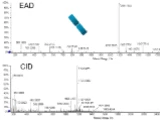
Increased demand for comprehensive biologics characterization has led to an increase in top-down mass spectrometry approaches. LC-MS characterization and quantification at the intact or subunit level offer the advantage of a direct observation of the intact molecule or subunit. Post-translational modifications can be localized to specific residues, or the specific proteoform present in the biological setting can be quantified. However, widespread adoption is limited due to lack of availability of comprehensive fragmentation modes, and lower sensitivity compared to peptides. Here, a novel QTOF instrument (SCIEX) equipped with two fragmentation capabilities: electron-capture dissociation (ECD) and collision-induced dissociation (CID), was used, enabling improved sequence coverage for top-down characterization. The novel type of ECD is tunable up to 25 eV, covering modes of ECD, hot ECD, and excitation of ions from organics (EIEIO). Being embedded in a magnetic ion trap, highly efficient fragmentation can be achieved, while reaction times can be set as low as 20 ms. Antibody reference standard and serum samples (containing the antibody drug either spiked-in or dosed) were analyzed for both intact or subunit quantification via MS1, and subunit characterization via MS/MS. Dosed samples were collected at various time points, followed by immunocapture, reduction and LC-MS/MS analysis. Absolute quantification was performed at either the extracted ion chromatogram level or based on the deconvoluted mass using SCIEX OS software. Example absolute quantification is shown over a range of 2-50 µg/mL. Middle-down data was processed by ProteoWizard and MASH software suites, and characterization was performed using ProSightPC software. The data derived from ECD and CID proved to be complimentary, with EAD mainly providing information on the C- and N-termini, whereas CID provided larger fragments towards the middle of the protein sequence. In summary, this analytical workflow and instrumental setup enabled characterization and quantification of mAb subunits using a novel QTOF system.
Contact Information
Team Members

Kerstin Pohl
SCIEX
Presenter
Jason Causon
SCIEX
Co-Author
John (Jack) Kellie
GlaxoSmithKline
Co-Author